Horizontal and vertical curves are the computational core of geometric design, the first of the five subtopics NCEES lists under Transportation Engineering. The questions are short and they repeat in a few forms: given two elements of a curve, find a third; put a station on the PC or the PT; find the elevation of a point on a vertical curve, or of its high or low point.
The five problems below cover both curve types, from a one-line long chord to the high point of a crest curve, all in feet and stations. Pick an answer to check it, then open the worked solution, which shows every substitution.
Where this sits: NCEES lists Transportation Engineering at 9-14 questions of the 110 on the FE Civil exam, and geometric design (e.g., streets, highways, intersections) is subtopic A of the area. NCEES does not publish question counts below that level.
The Curve Relationships These Problems Use
The FE Reference Handbook covers both curve types in its Transportation section, under Horizontal Curves and Vertical Curves. These are the relationships the five problems on this page use; knowing them on sight is what makes the lookup fast.
Horizontal curve (radius \( R \), intersection angle \( \Delta \))
- Tangent length: \( T = R\tan(\Delta/2) \)
- Curve length: \( L = \pi R\Delta/180^\circ \)
- Long chord: \( \mathrm{LC} = 2R\sin(\Delta/2) \)
- External distance: \( E = R\left[1/\cos(\Delta/2) - 1\right] \)
- Middle ordinate: \( M = R\left[1 - \cos(\Delta/2)\right] \)
- Stations: \( \mathrm{PC} = \mathrm{PI} - T \), then \( \mathrm{PT} = \mathrm{PC} + L \)
Vertical curve (grades \( g_1 \), \( g_2 \) as decimals, \( x \) in feet from the PVC)
- Elevation on the curve: \( y = y_{\mathrm{PVC}} + g_1 x + (g_2 - g_1)\,x^2/(2L) \)
- High or low point: \( x = -g_1 L/(g_2 - g_1) \)
- PVC from the PVI: \( y_{\mathrm{PVC}} = y_{\mathrm{PVI}} - g_1 L/2 \)
- Rate of vertical curvature: \( K = L/A \), with \( A = |g_2 - g_1| \) in percent
5 Free Horizontal and Vertical Curve Problems
Give yourself about three minutes for each one, roughly the pace of the exam, and work it on paper before you look at the solution.
Problem 1 — Long Chord from R and Δ
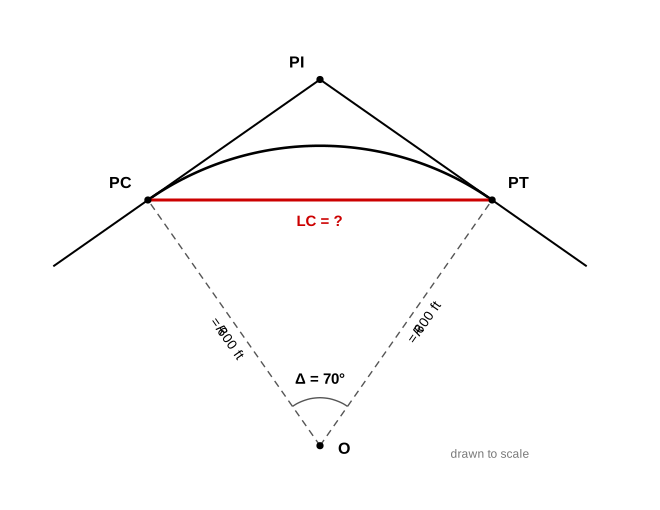
A simple circular curve has radius \( R = 600 \,\mathrm{ft} \) and intersection angle \( \Delta = 70^{\circ} \). What is the long chord \( LC \) (\( \mathrm{ft} \)), nearest \( 1 \,\mathrm{ft} \)?
Answer: B) \( 688\,\mathrm{ft} \)
Step 1 – Identify given information: Radius \( R = 600 \;\text{ft} \), intersection angle \( \Delta = 70^{\circ} \).
Step 2 – Long chord formula: From the FE Handbook:
$$LC = 2R \sin\!\left(\dfrac{\Delta}{2}\right)$$
Step 3 – Substitute and solve:
$$LC = 2(600) \sin(35^{\circ}) = 1200 \times 0.5736 = 688.3 \;\text{ft} \approx 688 \;\text{ft}$$
Step 4 – Answer: \( LC \approx 688 \;\text{ft} \). Note that the long chord is always shorter than the curve arc length \( L = R\Delta(\pi/180) = 733 \;\text{ft} \) because the chord cuts straight across.
Correct answer: (B)
Problem 2 — Radius from the Long Chord
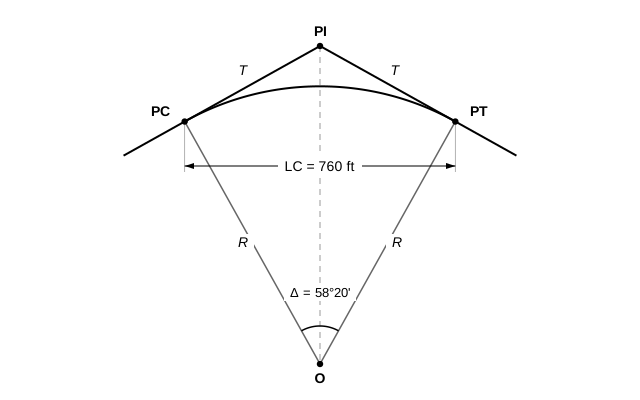
A simple circular horizontal curve has intersection angle \( \Delta = 58^{\circ} 20' \) and long chord \( LC = 760 \,\mathrm{ft} \). What is the curve radius \( R \) (\( \mathrm{ft} \)), nearest \( 10 \,\mathrm{ft} \)?
Answer: D) \( 780\,\mathrm{ft} \)
Step 1 – Identify given information:
| Intersection angle | \( \Delta = 58^{\circ}20' = 58.333^{\circ} \) |
| Long chord | \( LC = 760 \;\text{ft} \) |
Step 2 – Long chord formula: From the FE Handbook, the long chord of a simple circular curve relates to the radius and intersection angle by:
$$LC = 2R \sin\!\left(\dfrac{\Delta}{2}\right)$$
Rearranging for \( R \): \( R = \dfrac{LC}{2 \sin(\Delta/2)} \)
Step 3 – Substitute and solve:
$$R = \dfrac{760}{2 \sin(58.333^{\circ}/2)} = \dfrac{760}{2 \sin(29.167^{\circ})} = \dfrac{760}{2(0.4873)} = \dfrac{760}{0.9747} = 779.7 \;\text{ft}$$
Step 4 – Answer: Rounded to the nearest \( 10 \;\text{ft} \): \( R \approx 780 \;\text{ft} \). Option (B) \( 730 \) is too small, (C) \( 760 \) would be the radius only if \( \Delta \) were exactly \( 60^{\circ} \) (\( \sin 30^{\circ} = 0.5 \)) — a tempting round-number trap, and (D) \( 820 \) overshoots the calculation.
(A) \( 450\,\text{ft} \) puts the full intersection angle into the long-chord relation, dividing by \( 2\sin(58^{\circ}20') \) instead of \( 2\sin(29^{\circ}10') \).
(B) \( 730\,\text{ft} \) is close to the answer but follows from neither route.
(C) \( 760\,\text{ft} \) is the long chord itself, not the radius.
Correct answer: (D)
Problem 3 — Station of the PC
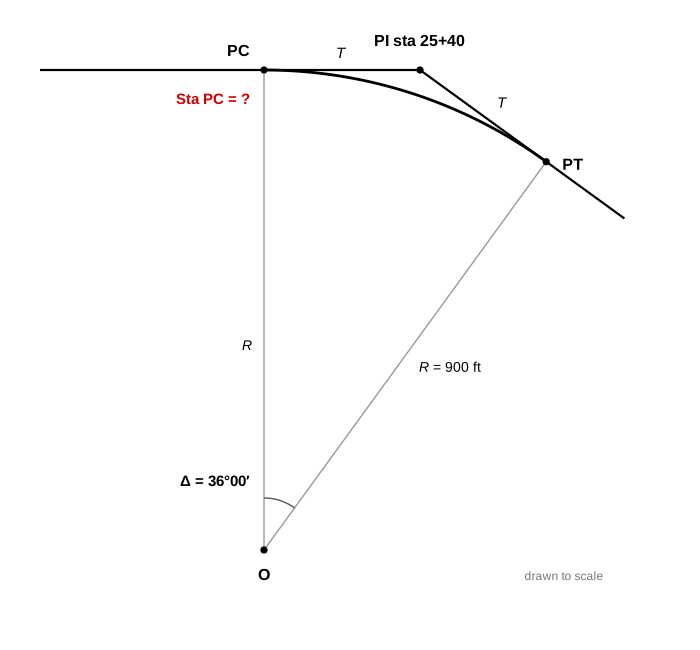
A horizontal curve has \( PI \) at \( \text{sta } 25+40 \), radius \( R = 900 \,\mathrm{ft} \), and intersection angle \( \Delta = 36^{\circ} 00' \). What is the station of \( PC \) (nearest \( 1 \,\mathrm{ft} \))?
Answer: A) \( \text{sta } 22+48 \)
Step 1 – Identify given information:
PI at sta 25+40 (station value \( 2540.0 \) ft), \( R = 900 \) ft, \( \Delta = 36^{\circ}00' \).
Step 2 – Tangent distance:
$$T = R\,\tan\!\left(\dfrac{\Delta}{2}\right) = 900\,\tan(18^{\circ}) = 900(0.3249) = 292.4 \;\text{ft}$$
The PC lies \( T \) feet before the PI, measured back along the tangent.
Step 3 – Station of PC:
$$\text{sta PC} = \text{sta PI} - T = 2540.0 - 292.4 = 2247.6 \;\text{ft} = \text{sta } 22+47.6 \approx \text{sta } 22+48$$
Step 4 – Answer: sta \( 22+48 \). Stationing is always adjusted with the tangent distance \( T \) — never by subtracting the arc length \( L \) or half the chord. (The PT, in contrast, is found by adding \( L \) to the PC station along the curve.)
Correct answer: (A)
Problem 4 — PVC Elevation on a Sag Curve
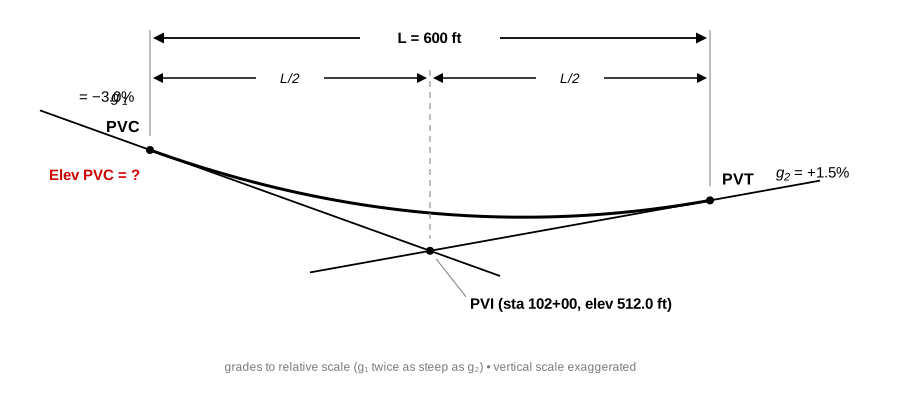
A symmetric sag vertical curve has length \( L = 600 \,\mathrm{ft} \) connecting \( g_1 = -3.0\% \) to \( g_2 = +1.5\% \). The \( PVI \) is at \( \text{sta } 102+00 \) with elevation \( 512.0 \,\mathrm{ft} \). What is the elevation of \( PVC \) (\( \mathrm{ft} \))?
Answer: C) \( 521.0\,\mathrm{ft} \)
Step 1 – Identify given information:
Symmetric sag curve: \( L = 600 \) ft, \( g_1 = -3.0\% \), \( g_2 = +1.5\% \), PVI at sta 102+00 with elevation \( 512.0 \) ft.
Step 2 – Locate the PVC:
For a symmetric curve the PVI sits at midlength, so the PVC is \( L/2 = 300 \) ft before the PVI (sta 99+00).
Step 3 – Elevation of PVC (walk back up the entering grade):
$$\text{Elev}_{PVC} = \text{Elev}_{PVI} - g_1\!\left(\dfrac{L}{2}\right) = 512.0 - (-0.03)(300) = 512.0 + 9.0 = 521.0 \;\text{ft}$$
The \( -3.0\% \) grade descends toward the PVI, so moving backward the roadway is higher.
Step 4 – Answer: \( 521.0 \) ft. Option (A) \( 503.0 \) applies the grade in the wrong direction (\( 512.0 - 9.0 \)), and (B) \( 512.0 \) forgets the tangent grade entirely.
Correct answer: (C)
Problem 5 — High Point of a Crest Curve
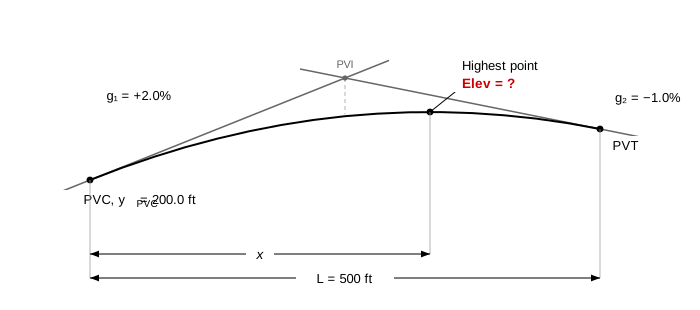
A crest vertical curve has \( y_{PVC} = 200.0 \,\mathrm{ft} \), \( L = 500 \,\mathrm{ft} \), \( g_1 = +2.0\% \), and \( g_2 = -1.0\% \). What is the elevation at the highest point (\( \mathrm{ft} \)), nearest \( 0.1 \,\mathrm{ft} \)?
Answer: B) \( 203.3\,\mathrm{ft} \)
Step 1 – Identify given information:
\( y_{PVC} = 200.0 \) ft, \( L = 500 \) ft, \( g_1 = +2.0\% \), \( g_2 = -1.0\% \).
Step 2 – Locate the highest point:
The grade along the parabola varies linearly and is zero at the crest:
$$x = \dfrac{-g_1 L}{g_2 - g_1} = \dfrac{-(0.02)(500)}{-0.030} = 333.3 \;\text{ft from the PVC}$$
Step 3 – Elevation from the curve equation:
$$y = y_{PVC} + g_1 x + \dfrac{g_2 - g_1}{2L}\,x^2$$
$$y = 200.0 + (0.02)(333.3) + \dfrac{-0.030}{1000}(333.3)^2 = 200.0 + 6.67 - 3.33 = 203.3 \;\text{ft}$$
Step 4 – Answer: \( 203.3 \) ft. As always at the zero-grade point, the parabolic term takes back exactly half of the tangent rise (\( +6.67 \) ft up the tangent, \( -3.33 \) ft correction) — the crest always sits below its tangent, never above it.
Correct answer: (B)
Three Mistakes That Cost Points
- Feeding degrees and minutes straight into the calculator. An intersection angle of 58°20′ is 58.333°, not 58.20°. Convert the minutes before the angle goes into a sine, a tangent or the curve length, or every element of the curve comes out slightly wrong and lands near a distractor.
- Using percent where the parabola wants a decimal. In the elevation equation a grade of −3% enters as −0.03. The rate of curvature is the exception: \( K = L/A \) takes \( A \) in percent, so the same curve gives K in feet per percent.
- Measuring x from the PVI. The vertical curve equation measures x from the PVC. When a point is given by its station, subtract the PVC station first; the PVI sits half a curve length further along.
Frequently Asked Questions
How many curve questions are on the FE Civil exam?
NCEES does not publish counts below the knowledge-area level. Transportation Engineering carries 9 to 14 of the 110 questions, and horizontal and vertical curves are the most computational part of geometric design, its first subtopic, so expect them in some form.
Do I need to memorize the curve formulas?
No. The FE Reference Handbook has them. What you need is to recognize which elements a problem gives you and which one it asks for, and to know the stationing and sign conventions, because the Handbook will not catch those mistakes for you.
When does a vertical curve have its high or low point inside the curve?
Only when the two grades have opposite signs. The turning point is where the grade along the curve reaches zero, and its distance from the PVC is the high or low point formula in the list above. If both grades are positive or both are negative, the highest or lowest point of the curve is at one of its ends.
Keep Going
Practice the rest of the area on the FE Civil transportation engineering practice problems page, or keep going with the sight distance and superelevation problems. To see these topics mixed with the other 13 areas, take the free FE Civil practice exam, or browse every topic in the free FE Civil practice problems hub.