Start with any of the 14 FE Mechanical topic sets below. Every problem is original, written against the current NCEES FE Mechanical exam specification, and comes with a step-by-step solution that cites where the equation lives in the FE Reference Handbook. There are 76 free problems in total — no account, no card, no email required.
The table is ordered by exam weight rather than alphabetically, because on a 110-question paper those weights decide where your study hours belong. The four heaviest areas — Dynamics, Kinematics, and Vibrations, Fluid Mechanics, Mechanical Design and Analysis and Thermodynamics — are worth 10 to 15 questions each. Together they can account for close to half the exam.
Try These Featured Visual Problems
These come straight from the FEExamClick FE Mechanical bank — the same clean, exam-style diagrams you get inside the platform. Pick an answer and see instantly whether you are right.
Mechanical Design — Bars in Series
Two steel bars are connected in series. Bar 1 has length 0.5 m and area 400 mm\(^{2}\); Bar 2 has length 0.8 m and area 200 mm\(^{2}\). Both have E = 200 GPa. Under an axial load of 20 kN, the total elongation (mm) is most nearly:

Answer: A) 0.525
Refer to the Machine Design section in the Mechanical Engineering chapter of the FE Reference Handbook.
Total elongation:
\(\delta = \frac{PL_1}{A_1 E} + \frac{PL_2}{A_2 E}\)
$$= \frac{20{,}000 \times 0.5}{400 \times 10^{-6} \times 200 \times 10^9} + \frac{20{,}000 \times 0.8}{200 \times 10^{-6} \times 200 \times 10^9}$$
\(= \frac{10{,}000}{80{,}000{,}000} + \frac{16{,}000}{40{,}000{,}000} = 1.25 \times 10^{-4} + 4.00 \times 10^{-4} = 5.25 \times 10^{-4}\) m
\(\delta = 0.525\) mm
Engineering Economics — Break-Even Volume
A company manufactures fabricated ductwork sections with the following cost structure, shown on the break-even chart:
• Fixed costs: \(\$240{,}000\) per year
• Variable cost: \(\$18\) per unit
• Selling price: \(\$30\) per unit
How many duct sections must be sold annually to break even?

Answer: C) 20{,}000 units
Handbook: FE Reference Handbook 10.6, Engineering Economics → Breakeven Analysis, p. 236 (PDF viewer: page 242). The page defines the breakeven point in words but gives no formula, so set the equation up yourself.
Step 1 – Write both lines.
$$\text{Revenue} = 30Q, \qquad \text{Total cost} = 240{,}000 + 18Q$$
Step 2 – Set them equal and solve.
$$30Q = 240{,}000 + 18Q \quad\Longrightarrow\quad 12Q = 240{,}000$$
$$Q^{*} = \frac{240{,}000}{30 - 18} = \mathbf{20{,}000 \text{ units}}$$
Step 3 – Answer: (C).
Think in contribution margin. Every duct section sells for \(\$30\) and costs \(\$18\) to build, so it contributes \(\$12\) toward the fixed costs. Covering \(\$240{,}000\) of fixed cost therefore takes \(240{,}000/12 = 20{,}000\) units. The margin — not the price, not the variable cost — is the only rate that matters.
Check it. At 20,000 units: revenue \(= 30(20{,}000) = \$600{,}000\); total cost \(= 240{,}000 + 18(20{,}000) = 240{,}000 + 360{,}000 = \$600{,}000\). They match.
A note on the margin. Here the contribution is 40% of the selling price (\(\$12\) of \(\$30\)), a thinner margin than it looks: the plant must move 20,000 units a year before it earns its first dollar of profit.
Step 4 – Eliminate the distractors. Each divides the fixed cost by the wrong figure:
(A) 13,333 units \(= 240{,}000/18\) divides by the variable cost. That number answers a different question entirely — how many units' worth of variable cost equals the fixed cost.
(B) 8,000 units \(= 240{,}000/30\) divides by the price, as though all \(\$30\) of each sale were available to cover fixed costs. It ignores the \(\$18\) spent to build each unit.
(D) 5,000 units \(= 240{,}000/(30 + 18)\) adds the variable cost to the price instead of subtracting it. A sign error, and it makes the operation look four times more profitable than it is.
Mathematics — Flowchart Loop Count
A flowchart segment reads:
Set VAR = 100
While VAR > 1
VAR = VAR / 2
COUNT = COUNT + 1
End While
If COUNT starts at 0, the value of COUNT at the conclusion is most nearly:

Answer: D) 7
Refer to the Software Syntax Guidelines section (p. 417) in the Electrical and Computer Engineering chapter of the FE Reference Handbook.
Tracing through the loop:
Iteration 1: VAR = 50, COUNT = 1
Iteration 2: VAR = 25, COUNT = 2
Iteration 3: VAR = 12.5, COUNT = 3
Iteration 4: VAR = 6.25, COUNT = 4
Iteration 5: VAR = 3.125, COUNT = 5
Iteration 6: VAR = 1.5625, COUNT = 6
Iteration 7: VAR = 0.78125, COUNT = 7 → exit (VAR ≤ 1)
This is essentially \(\lfloor\log_2(100)\rfloor + 1 = 7\).
Statics — Cable Tensions at a Joint
Three cables support a weight W at point O. Cable 1 has tension T\(_{1}\) at angle 30° from vertical, Cable 2 has tension T\(_{2}\) at angle 45° from vertical on the opposite side. If W = 1000 N and the system is in equilibrium, what is T\(_{1}\)?

Answer: B) 732 N
Equilibrium equations (angles from vertical):
\(\Sigma F_x = 0\): \(T_1\sin(30^{\circ}) - T_2\sin(45^{\circ}) = 0\)
\(\Sigma F_y = 0\): \(T_1\cos(30^{\circ}) + T_2\cos(45^{\circ}) - 1000 = 0\)
From first equation: \(T_2 = 0.707T_1\)
Substitute into second:
\(0.866T_1 + 0.5T_1 = 1000\)
$$1.366T_1 = 1000$$
$$\boxed{T_1 = 732 \text{ N}}$$
Heat Transfer — Heat Loss from an Insulated Steam Pipe
A 2-in. Schedule 40 steel pipe (OD = 2.375 in., ID = 2.067 in., \(k_{\text{steel}}\) = 30 Btu/(h·ft·°F)) carries steam. The pipe is covered with 2-in. thick insulation (\(k_{\text{ins}}\) = 0.03 Btu/(h·ft·°F)). The inner pipe surface is at 350°F and the outer insulation surface is at 90°F. The heat loss per foot of pipe (Btu/(h·ft)) is most nearly:

Answer: B) 50
Refer to the Conduction section in the Heat Transfer chapter of the FE Reference Handbook.
Convert radii to feet:
\(r_1 = 2.067/(2 \times 12) = 0.08613 ft\)
\(r_2 = 2.375/(2 \times 12) = 0.09896 ft\)
\(r_3 = r_2 + 2/12 = 0.09896 + 0.16667 = 0.26563 ft\)
Thermal resistances per unit length:
\(R_{steel} = \ln(r_2/r_1)/(2\pi k_{steel}) = \ln(1.149)/188.5 = 0.1390/188.5 = 0.000737 h\cdot ft\cdot ^{\circ}F/Btu\)
$$R_{ins} = \ln(r_3/r_2)/(2\pi k_{ins}) = \ln(2.684)/0.1885 = 0.9876/0.1885 = 5.239 h\cdot ft\cdot ^{\circ}F/Btu$$
$$R_{total} = 0.000737 + 5.239 = 5.240$$
$$\boxed{Q/L = (350 - 90)/5.240 = 260/5.240 = 49.6 \approx 50 Btu/(h\cdot ft)}$$
Note: The insulation dominates the thermal resistance.
Mechanics of Materials — Maximum Principal Stress
For the plane stress element shown (σx = 80 MPa, σy = 20 MPa, τxy = 30 MPa), the maximum principal stress is most nearly:
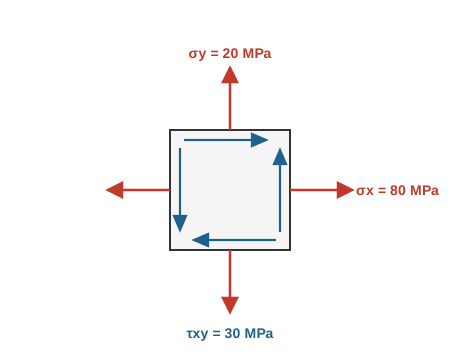
Answer: A) 92 MPa
The principal stresses are:
$$\sigma_{1,2} = \frac{\sigma_x + \sigma_y}{2} \pm \sqrt{\left(\frac{\sigma_x - \sigma_y}{2}\right)^2 + \tau_{xy}^2}$$
$$\sigma_{1} = \frac{80 + 20}{2} + \sqrt{\left(\frac{80 - 20}{2}\right)^2 + 30^2} = 50 + \sqrt{30^2 + 30^2}$$
$$\sigma_{1} = 50 + 42.4 = 92.4\ \text{MPa}$$
$$\boxed{\sigma_{1} \approx 92\ \text{MPa}}$$
Want problems like these for every topic? The full platform has 1,500+ FE Mechanical problems — each with a worked, step-by-step solution, plus timed CBT simulations under the real 5 hr 20 min clock. Start your 7-day free trial →
Free FE Mechanical practice problems by topic
| FE Mechanical topic | Free problems | Difficulty | Approx. time | Questions on the real exam |
|---|---|---|---|---|
| FE Mechanical Dynamics, Kinematics, and Vibrations | 5 | 1 easy · 2 med · 2 hard | ~15 min | 10-15 |
| FE Mechanical Fluid Mechanics | 5 | 1 easy · 2 med · 2 hard | ~15 min | 10-15 |
| FE Mechanical Mechanical Design and Analysis | 5 | 1 easy · 2 med · 2 hard | ~15 min | 10-15 |
| FE Mechanical Thermodynamics | 5 | 1 easy · 2 med · 2 hard | ~15 min | 10-15 |
| FE Mechanical Mechanics of Materials | 5 | 1 easy · 2 med · 2 hard | ~15 min | 9-14 |
| FE Mechanical Statics | 5 | 1 easy · 2 med · 2 hard | ~15 min | 9-14 |
| FE Mechanical Heat Transfer | 5 | 1 easy · 2 med · 2 hard | ~15 min | 7-11 |
| FE Mechanical Material Properties and Processing | 5 | 1 easy · 2 med · 2 hard | ~15 min | 7-11 |
| FE Mechanical Mathematics | 5 | 1 easy · 2 med · 2 hard | ~15 min | 6-9 |
| FE Mechanical Electricity and Magnetism | 5 | 1 easy · 2 med · 2 hard | ~15 min | 5-8 |
| FE Mechanical Measurements, Instrumentation, and Controls | 5 | 1 easy · 2 med · 2 hard | ~15 min | 5-8 |
| FE Mechanical Engineering Economics | 5 | 1 easy · 2 med · 2 hard | ~15 min | 4-6 |
| FE Mechanical Ethics and Professional Practice | 5 | 1 easy · 2 med · 2 hard | ~15 min | 4-6 |
| FE Mechanical Probability and Statistics | 5 | 1 easy · 2 med · 2 hard | ~15 min | 4-6 |
| Total free problems (plus 6 featured above) | 70 | — | ~3.5 hr | 110 on exam day |
How FE Mechanical differs from FE Civil
Both exams run 110 questions in 5 hours and 20 minutes of testing time, inside a six-hour appointment that also covers the nondisclosure agreement, the tutorial and a 25-minute scheduled break. The topic lists are where they diverge.
Four FE Mechanical knowledge areas have no counterpart at all on FE Civil: FE Mechanical Thermodynamics, FE Mechanical Heat Transfer, Measurements, Instrumentation and Controls, and FE Mechanical Mechanical Design and Analysis. Together they are worth roughly a third of the paper. Dynamics is also weighted far more heavily here, at 10-15 questions against 4-6 on the civil exam.
This is why a question bank shared between disciplines serves neither well. Our FE Mechanical exam prep and FE Civil exam prep banks are built and maintained separately.
How to use these problem sets
Work each problem on paper before revealing the solution. Reading a worked solution you have not attempted builds recognition, not recall, and recognition is precisely what fails under exam pressure. Keep the FE Reference Handbook open while you practise, because finding an equation quickly is a skill the exam tests just as directly as applying it.
Time yourself at about three minutes per question. That is the pace 110 questions in 5 hours 20 minutes demands, and it is the reason candidates who only ever practise untimed are surprised on exam day.
Where to start
If your exam is months away, work down the table from the top so your hours land on the heaviest areas first. If it is weeks away, start instead with FE Mechanical Ethics and FE Mechanical Engineering Economics: together they are 8-12 questions, they need no derivation, and they are the fastest points on the paper to secure.
For a full schedule, see how long to study for the FE exam and the week-by-week FE study plan. To rehearse under real conditions, the FE Mechanical platform includes full-length CBT simulations timed to the same 5 hr 20 min window.