Earthwork and volume computations are subtopic C of Surveying on the FE Civil exam, and they are mostly careful bookkeeping with cross sections: average two end areas, weight a middle one, add up grid cells, and keep cut and fill straight along a mass diagram.
The five problems below, all in US units, use the average end area and prismoidal methods, a borrow pit grid cell, a mass haul ordinate and a shrinkage allowance. Every answer is in cubic yards.
Where this sits: NCEES lists Surveying at 6-9 questions of the 110 on the FE Civil exam, and earthwork and volume computations is subtopic C of the area. NCEES does not publish question counts below that level.
The Volume Relationships These Problems Use
The FE Reference Handbook gives the end-area and prismoidal formulas; areas in ft2, lengths in ft, and 27 ft3 to a cubic yard.
- Average end area: \( V = L\,\dfrac{A_1 + A_2}{2} \)
- Prismoidal formula: \( V = \dfrac{L}{6}\,(A_1 + 4A_m + A_2) \), with \( A_m \) measured at the middle section
- Borrow pit cell: \( V = A_{cell}\,\bar h \), with \( \bar h \) the mean of the corner depths
- Mass haul ordinate: the running total of cut (+) and fill (−) volumes along the alignment
5 Free Earthwork Volume Problems
Give yourself about three minutes for each one, roughly the pace of the exam, and work it on paper before you look at the solution.
Problem 1 — Average End Area Volume
Using the Average End Area method, areas at consecutive stations are \( A_1 = 90\,\mathrm{ft}^2 \) and \( A_2 = 150\,\mathrm{ft}^2 \) separated by \( L = 150\,\mathrm{ft} \). What is the volume \( (\mathrm{yd}^3) \)?

Answer: A) \( 667\,\mathrm{yd}^3 \)
Step 1 – Identify given information:
| Parameter | Value |
|---|---|
| \( A_1 \) | \( 90\,\text{ft}^2 \) |
| \( A_2 \) | \( 150\,\text{ft}^2 \) |
| Station spacing \( L \) | \( 150\,\text{ft} \) |
Step 2 – Average End Area method (FE Handbook):
\( V = \dfrac{L(A_1 + A_2)}{2} \)
Convert ft\(^3\) to yd\(^3\) by dividing by 27.
Step 3 – Substitute and solve:
\( V = \dfrac{150(90 + 150)}{2} = \dfrac{150 \times 240}{2} = 18{,}000\,\text{ft}^3 \)
\( V = \dfrac{18{,}000}{27} = 666.7 \approx 667\,\text{yd}^3 \)
Step 4 – Answer:
The volume is approximately \( 667\,\text{yd}^3 \).
(B) \( 800\,\text{yd}^3 \) and (C) \( 900\,\text{yd}^3 \) overestimate the result.
(D) \( 1{,}333\,\text{yd}^3 \) is exactly twice the answer: it multiplies the length by the sum of the end areas instead of by their average.
Remember: \( 1\,\text{yd}^3 = 27\,\text{ft}^3 \).
Correct answer: (A)
Problem 2 — Fill with a Shrinkage Allowance
A project needs \( 1{,}000\,\mathrm{yd}^3 \) of compacted fill. If a shrinkage factor of \( 12\% \) is used (increase fill by this factor), what loose fill volume should be planned?

Answer: D) \( 1{,}120\,\mathrm{yd}^3 \)
Step 1 – Identify given information:
| Parameter | Value |
|---|---|
| Required compacted fill | \( 1{,}000\,\text{yd}^3 \) |
| Shrinkage factor | \( 12\% \) |
Step 2 – Shrinkage adjustment (FE Handbook):
Shrinkage means soil compresses when placed as fill, so you need more loose material:
\( V_{\text{loose}} = V_{\text{compacted}} \times (1 + \text{shrinkage}) \)
Step 3 – Substitute and solve:
\( V_{\text{loose}} = 1{,}000 \times (1 + 0.12) = 1{,}000 \times 1.12 = 1{,}120\,\text{yd}^3 \)
Step 4 – Answer:
You need \( 1{,}120\,\text{yd}^3 \) of loose fill to achieve \( 1{,}000\,\text{yd}^3 \) compacted.
(A) \( 774\,\text{yd}^3 \) applies the 0.88 factor twice and in the shrinking direction, \( 1{,}000 \times 0.88 \times 0.88 \).
(B) \( 880\,\text{yd}^3 \) subtracts the 12 per cent instead of adding it.
(C) \( 1{,}000\,\text{yd}^3 \) ignores shrinkage entirely.
Correct answer: (D)
Problem 3 — Prismoidal Volume
Prismoidal method: \( A_1 = 40\,\mathrm{ft}^2 \), \( A_m = 55\,\mathrm{ft}^2 \), \( A_2 = 70\,\mathrm{ft}^2 \), with \( L = 100\,\mathrm{ft} \). What is the volume \( (\mathrm{yd}^3) \)?

Answer: D) \( 204\,\mathrm{yd}^3 \)
Step 1 – Identify given information:
| Parameter | Value |
|---|---|
| \( A_1 \) (end area) | \( 40\,\text{ft}^2 \) |
| \( A_m \) (middle area) | \( 55\,\text{ft}^2 \) |
| \( A_2 \) (end area) | \( 70\,\text{ft}^2 \) |
| \( L \) (length) | \( 100\,\text{ft} \) |
Step 2 – Prismoidal formula (FE Handbook):
\( V = \dfrac{L(A_1 + 4A_m + A_2)}{6} \)
This method is more accurate than Average End Area because it accounts for the middle cross section.
Step 3 – Substitute and solve:
\( V = \dfrac{100(40 + 4(55) + 70)}{6} = \dfrac{100(40 + 220 + 70)}{6} = \dfrac{100 \times 330}{6} = 5{,}500\,\text{ft}^3 \)
\( V = \dfrac{5{,}500}{27} = 203.7 \approx 204\,\text{yd}^3 \)
Step 4 – Answer:
The prismoidal volume is approximately \( 204\,\text{yd}^3 \).
(A) \( 102\,\text{yd}^3 \) adds the three areas over 6 without giving the middle one its weight of 4, which returns exactly half the volume.
(B) \( 150\,\text{yd}^3 \) underestimates.
(C) \( 200\,\text{yd}^3 \) is the same \( 5{,}500\,\text{ft}^3 \) rounded off; \( 5{,}500/27 = 203.7 \), not 200.
Correct answer: (D)
Problem 4 — Borrow Pit Grid Cell
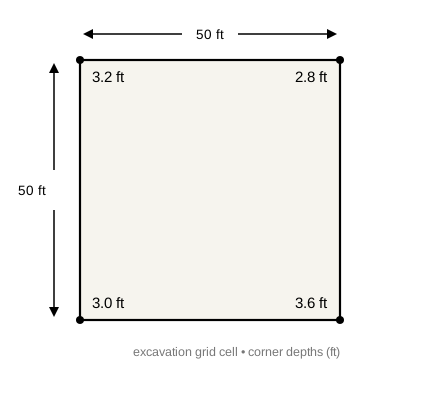
An excavation grid cell is \( 50 \,\mathrm{ft} \) \(\times\) \( 50 \,\mathrm{ft} \). Corner depths are \( 3.2 \,\mathrm{ft} \), \( 2.8 \,\mathrm{ft} \), \( 3.6 \,\mathrm{ft} \), and \( 3.0 \,\mathrm{ft} \). Using average corner depth, what is the excavation volume (\( \mathrm{yd}^{3} \)), nearest \( 1 \,\mathrm{yd}^{3} \)?
Answer: C) \( 292\,\mathrm{yd}^{3} \)
Step 1 – Identify given information:
One 50 ft × 50 ft cell (\( A = 2500 \) ft\(^2\)); corner depths 3.2, 2.8, 3.6 and 3.0 ft.
Step 2 – Average corner depth:
$$d_{avg} = \dfrac{3.2+2.8+3.6+3.0}{4} = \dfrac{12.6}{4} = 3.15 \;\text{ft}$$
Step 3 – Volume and convert:
$$V = 2500(3.15) = 7875 \;\text{ft}^3 \qquad \dfrac{7875}{27} = 291.7 \approx 292 \;\text{yd}^3$$
Step 4 – Answer: \( 292 \) yd\(^3\). Remember the conversion: \( 1 \;\text{yd}^3 = 27 \;\text{ft}^3 \) — skipping it is the classic slip.
(A) \( 208\,\text{yd}^3 \) averages only three of the four corner depths while still dividing by four, giving 2.25 ft of average depth instead of 3.15 ft.
Correct answer: (C)
Problem 5 — Mass Haul Ordinate
Mass haul: Between stations, the net volumes are: 0-1: \( +200\,\mathrm{yd}^3 \) (cut), 1-2: \( -150\,\mathrm{yd}^3 \) (fill), 2-3: \( +100\,\mathrm{yd}^3 \) (cut), 3-4: \( -300\,\mathrm{yd}^3 \) (fill). What is the mass haul ordinate at station 3?

Answer: B) \( +150\,\mathrm{yd}^3 \)
Step 1 – Identify given information:
| Interval | Net Volume (yd\(^3\)) | Type |
|---|---|---|
| 0-1 | \( +200 \) | Cut |
| 1-2 | \( -150 \) | Fill |
| 2-3 | \( +100 \) | Cut |
| 3-4 | \( -300 \) | Fill |
Step 2 – Mass haul ordinate concept (FE Handbook):
The mass haul ordinate at any station is the cumulative algebraic sum of cut (+) and fill (-) volumes from the starting station.
Step 3 – Substitute and solve:
Ordinate at Station 3 = sum of intervals 0-1, 1-2, and 2-3:
\( M_3 = (+200) + (-150) + (+100) = +150\,\text{yd}^3 \)
Step 4 – Answer:
The mass haul ordinate at station 3 is \( +150\,\text{yd}^3 \) (net excess of cut over fill).
(A) \( +50\,\text{yd}^3 \) omits the third interval.
(C) \( -150\,\text{yd}^3 \) has the wrong sign.
(D) \( -250\,\text{yd}^3 \) includes the 3-4 interval, which is beyond station 3.
Correct answer: (B)
Three Mistakes That Cost Points
- Stopping at cubic feet. Areas times lengths give cubic feet, and the options are in cubic yards. Divide by 27, or a correct volume becomes a wrong answer.
- Taking Am as the average of the end areas. In the prismoidal formula \( A_m \) is the area of the middle section itself. If you replace it with \( (A_1 + A_2)/2 \), the formula collapses into the average end area method.
- Losing the sign on the mass diagram. Cut adds to the running total and fill subtracts from it. Where the total returns to zero, cut and fill have balanced between those two stations.
Frequently Asked Questions
Which is more accurate, average end area or prismoidal?
The prismoidal formula, because it uses a measured middle section. The average end area method usually overestimates the volume when the end areas differ a lot, but it is simpler and widely used for routine estimates.
What is the difference between swell and shrinkage?
Swell is the increase in volume when bank material is excavated and loosened. Shrinkage is the decrease when it is compacted in a fill. Read how the problem applies the percentage before you use it.
What does a mass haul diagram show?
The cumulative earthwork volume along the alignment. Rising parts are cut, falling parts are fill, and a horizontal line across the curve marks a balanced haul between two stations.
Keep Going
Practice the rest of the area on the FE Civil surveying practice problems page, or keep going with the area computation problems. To see these topics mixed with the other 13 areas, take the free FE Civil practice exam, or browse every topic in the free FE Civil practice problems hub.