Statics is worth 8 to 12 questions on the FE Civil exam, and it is the knowledge area most likely to reward pure speed. The algebra is short, the geometry is familiar, and almost every problem reduces to summing forces and moments. The problems below are the kind you should be finishing in under two minutes each.
Each problem here is followed by a full solution that shows the free-body diagram, the equilibrium equations actually written, and the sign convention used. Where the NCEES FE Reference Handbook supplies a formula or a table value, the solution names it, because on exam day you will be pulling that value from a search box rather than memory.
Exam weight: NCEES lists Statics at 8-12 questions of the 110-question FE Civil exam. Work each problem below on paper first, then reveal the worked solution — reading a solution you have not attempted builds recognition, not recall.
What NCEES Tests in Statics
The NCEES specification puts 8 to 12 statics questions on the 110-question FE Civil exam. Expect resultants of two- and three-dimensional force systems, concurrent and non-concurrent systems, equilibrium of a rigid body with pins, rollers and fixed supports, and equivalent force-couple systems replacing a distributed load with a single resultant at the centroid of the load diagram.
The rest of the area splits between trusses and frames, centroids and moments of inertia, and friction. Truss questions ask for one member force, so method of sections usually beats method of joints; zero-force members appear often enough to be worth recognizing on sight. Friction items test whether the block is on the verge of sliding or tipping, not just F equals mu times N.
5 Free Statics Practice Problems
Each statics problem below comes from the FEExamClick FE Civil question bank, with worked solutions, and matches the style, difficulty and format of the real exam. Attempt each one under a three-minute limit — roughly the pace the exam demands.
Problem 1 — C. Equilibrium of rigid bodies
A \( 400\,\mathrm{N} \) sign is supported by two identical cables that each make a \( 30^\circ \) angle above the horizontal (symmetric). What is the tension in each cable?
Answer: D) 400 N
Step 1 – Identify given information: Sign weight \(W = 400\,\mathrm{N}\), two symmetric cables each at \(30^{\circ}\) above horizontal.
Step 2 – Vertical equilibrium (FE Handbook): For two symmetric cables:
$$2T\sin\theta = W$$
Step 3 – Substitute and solve:
$$2T\sin 30^{\circ} = 400$$
$$2T(0.5) = 400 \quad \Rightarrow \quad T = 400\,\mathrm{N}$$
Step 4 – Answer: \(T = 400\,\mathrm{N}\) per cable. Notably, the cable tension equals the full weight because \(\sin 30^{\circ} = 0.5\) and there are 2 cables. Option (A) \(200\,\mathrm{N}\) would be correct only if cables were vertical (\(\theta = 90^{\circ}\)); (C) \(300\,\mathrm{N}\) and (D) \(800\,\mathrm{N}\) use incorrect angles. Shallower cable angles produce higher tensions.
Option (B) is what you get by resolving the cable force with the cosine of \(30^\circ\) instead of the sine: \(400/(2\cos 30^\circ) = 231\,\mathrm{N}\). The correct relation is \(2T\sin 30^\circ = 400\).
Correct answer: (D)
Problem 2 — A. Resultants of force systems
Two forces act at a point: \( F_1 = 500\,\mathrm{N} \) at \( 30^{\circ} \) above the +x-axis, and \( F_2 = 300\,\mathrm{N} \) downward (−y). What is the magnitude of the resultant?
Answer: C) 436 N
Step 1 – Identify given information:
| Force | Magnitude | Direction |
|---|---|---|
| \(F_1\) | \(500\,\mathrm{N}\) | \(30^{\circ}\) above +x-axis |
| \(F_2\) | \(300\,\mathrm{N}\) | Downward (\(-y\)) |
Step 2 – Resultant of concurrent forces (FE Handbook): Resolve each force into x and y components, then find the resultant magnitude: \(R = \sqrt{R_x^2 + R_y^2}\)
Step 3 – Resolve and compute:
$$R_x = 500\cos 30^{\circ} + 0 = 500(0.8660) = 433\,\mathrm{N}$$
$$R_y = 500\sin 30^{\circ} - 300 = 250 - 300 = -50\,\mathrm{N}$$
$$R = \sqrt{433^2 + (-50)^2} = \sqrt{187{,}489 + 2{,}500} = \sqrt{189{,}989} \approx 436\,\mathrm{N}$$
Step 4 – Answer: The resultant is approximately \(436\,\mathrm{N}\). Option (B) \(350\,\mathrm{N}\) neglects the x-component of \(F_1\); (D) \(550\,\mathrm{N}\) adds magnitudes incorrectly. Always resolve into components before combining.
Swapping sine and cosine when resolving the 500 N force at 30 degrees puts the large component on the y-axis, where the 300 N downward force cancels most of it, yielding 283 N.
Correct answer: (C)
Problem 3 — B. Equivalent force systems
A triangular distributed load increases linearly from 0 at \( x = 0 \) to \( 6\,\mathrm{kN/m} \) at \( x = 4\,\mathrm{m} \). What is the equivalent resultant and its location from \( x = 0 \)?

Answer: B) 12 kN at 2.67 m
Step 1 – Identify given information: A triangular distributed load increases from \(0\) at \(x = 0\) to \(w_0 = 6\,\mathrm{kN/m}\) at \(x = 4\,\mathrm{m}\).
Step 2 – Equivalent resultant of triangular load (FE Handbook): For a linearly varying load from 0 to \(w_0\) over length \(L\):
\(R = \frac{1}{2} w_0 L\) (area of the triangle)
\(\bar{x} = \frac{2}{3}L\) from the zero end (centroid of a triangle)
Step 3 – Substitute and solve:
$$R = \frac{1}{2}(6)(4) = 12\,\mathrm{kN}$$
\(\bar{x} = \frac{2}{3}(4) = 2.667\,\mathrm{m}\) from \(x = 0\)
Step 4 – Answer: \(R = 12\,\mathrm{kN}\) at \(\bar{x} = 2.67\,\mathrm{m}\). Option (A) uses \(\frac{1}{3}L\) for location (wrong centroid rule); (C) \(24\,\mathrm{kN}\) treats it as a uniform load (\(w_0 \times L\)); (D) \(6\,\mathrm{kN}\) takes only the peak intensity. Remember: the resultant acts at \(\frac{2}{3}\) of the base from the zero end.
Correct answer: (B)
Problem 4 — G. Static friction
A flat belt wraps \( 180^{\circ} \) around a pulley (\( \theta = \pi\,\mathrm{rad} \)) with coefficient of friction \( \mu = 0.25 \). If the slack-side tension is \( T_2 = 200\,\mathrm{N} \), what is the tight-side tension \( T_1 \)?
Answer: D) 439 N
Step 1 – Identify given information:
| Parameter | Value |
|---|---|
| Wrap angle \(\theta\) | \(180^{\circ} = \pi\,\mathrm{rad}\) |
| Coefficient of friction \(\mu\) | \(0.25\) |
| Slack-side tension \(T_2\) | \(200\,\mathrm{N}\) |
Step 2 – Belt friction (capstan) equation (FE Handbook):
$$\frac{T_1}{T_2} = e^{\mu\theta}$$
where \(T_1\) = tight side, \(T_2\) = slack side, \(\theta\) must be in radians.
Step 3 – Substitute and solve:
$$T_1 = T_2 \cdot e^{\mu\theta} = 200 \cdot e^{0.25 \times \pi} = 200 \cdot e^{0.7854}$$
$$= 200 \times 2.193 = 438.6 \approx 439\,\mathrm{N}$$
Step 4 – Answer: \(T_1 \approx 439\,\mathrm{N}\). Option (A) \(256\,\mathrm{N}\) drops the wrap angle from the exponent, computing \(200e^{0.25}\) instead of \(200e^{0.25\pi}\); (C) \(357\,\mathrm{N}\) linearises the belt equation, adding the friction term to the slack tension as \(200(1 + \mu\theta)\) rather than multiplying by \(e^{\mu\theta}\). The exponential relationship means friction amplifies tension considerably more than any linear model predicts.
Correct answer: (D)
Problem 5 — F. Area moments of inertia
Composite area: Square plate \( 8\,\mathrm{cm} \) by \( 8\,\mathrm{cm} \) with origin at bottom-left. A quarter-circle hole of radius \( 4\,\mathrm{cm} \) is removed from the bottom-left corner; the quarter circle is bounded by \( x = 0 \), \( y = 0 \), and the arc from \( (4,\,0) \) to \( (0,\,4) \). Find the polar moment of inertia \( J \) about the composite centroid (\( J = I_x + I_y \) about centroidal axes).
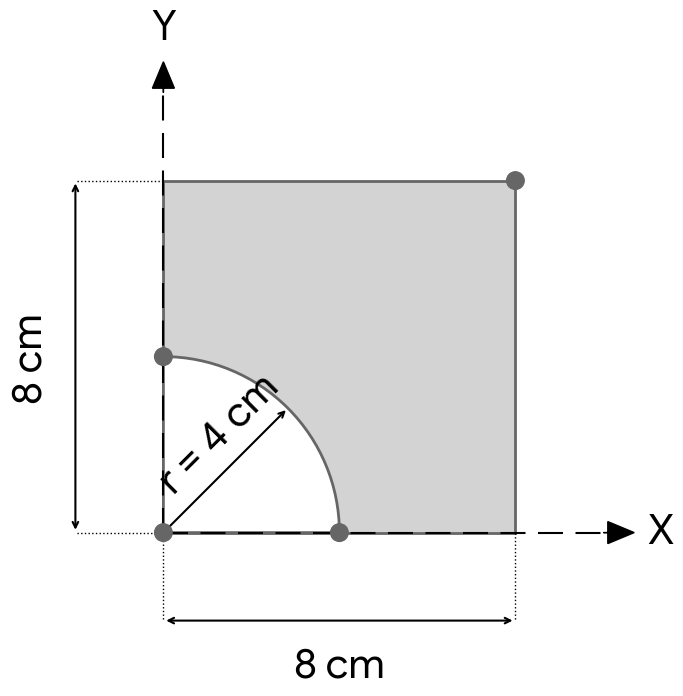
Answer: C) 489 cm\(^{4}\)
Step 1 – Identify given information: Same composite area as STAT072. \(\bar{x} = \bar{y} = 4.56\,\mathrm{cm}\). By symmetry \(I_x = I_y\), so \(J = 2I_x\).
Step 2 – Polar MOI formula (FE Handbook):
\(J = I_x + I_y = 2I_x\) (by symmetry of the shape)
For each shape, compute \(I_x\) about the composite centroid using parallel-axis theorem.
Step 3 – Compute \(I_x\) about composite centroid:
Square: \(I_{c,s} = 8^4/12 = 341.33\), \(d_s = 4 - 4.56 = -0.56\)
$$I_{x,s} = 341.33 + 64(0.56)^2 = 341.33 + 20.07 = 361.40$$
Quarter-circle: \(I_{c,q} = (\pi/16 - 4/(9\pi^2)) \times R^4 \approx 0.05488 \times 256 = 14.05\), \(d_q = 1.698 - 4.56 = -2.862\)
$$I_{x,q} = 14.05 + 12.566(2.862)^2 = 14.05 + 102.93 = 116.98$$
\(I_x = 361.40 - 116.98 = 244.42\), \(J = 2(244.42) = 488.8 \approx 489\,\mathrm{cm}^{4}\)
Step 4 – Answer: \(J \approx 489\,\mathrm{cm}^{4}\). Option (A) \(310\) computes only \(I_x\); (D) \(650\) uses wrong formula. (B) \(416\,\mathrm{cm}^{4}\) is what you get by reading the quarter circle's moment of inertia about its bounding edge (\(\pi R^{4}/16\)) as if it were the centroidal value and then still applying the parallel-axis shift, which subtracts the hole's offset twice.
Correct answer: (C)
Using the FE Reference Handbook for Statics
Do not derive centroids or moments of inertia. Search the handbook for the shape name and pull Ixc, Iyc and the centroid location straight from the table, then apply the parallel axis theorem yourself. Bookmark that table plus the friction and belt-friction relations before your first practice exam so the search is a reflex, not a hunt.
Four Mistakes That Cost Points
- Skipping the free-body diagram On a two-minute question the diagram feels like wasted time, but most wrong answers here come from a forgotten reaction component or a force drawn in the wrong direction. Sketch the body, mark every support reaction, then write equations.
- Choosing the wrong moment point Summing moments about an arbitrary origin leaves two unknowns in one equation. Take moments about a pin or about the intersection of two unknown lines of action and the target reaction usually falls out in a single line of algebra.
- Placing a distributed load resultant incorrectly A uniform load resultant sits at midspan; a triangular load resultant sits at one third of the base from the tall end. Reversing that third catches people every time, and the wrong answer choices are built to match the mistake.
- Forgetting the parallel axis term Table values for I are about the shape's own centroid. For a built-up section you still need A times d squared for each piece, measured from the composite centroid, not from the edge of the section. Locate the composite centroid first.
Frequently Asked Questions
How many statics questions are on the FE Civil exam?
The NCEES specification lists 8 to 12 statics questions out of 110. That makes it one of the two largest mechanics areas alongside mechanics of materials. Because the problems are short and formulaic, statics is usually the best return on study hours of any area on the exam.
Should I use method of joints or method of sections on the exam?
Sections, almost always. FE truss questions ask for the force in one named member, and a single cut through three members with one moment equation gets you there. Method of joints only wins when the member you want touches a support joint, or when you are checking for zero-force members.
Do I need to memorize moment of inertia formulas for statics?
No. The on-screen NCEES FE Reference Handbook contains centroid and area moment of inertia tables for rectangles, triangles, circles and semicircles, and you can search it during the exam. What you do need from memory is the parallel axis theorem and the habit of finding the composite centroid before shifting any axes.
How hard are FE Civil statics questions compared to a university statics course?
The mechanics is easier but the clock is tighter. Exam items are single-concept: one truss member, one reaction, one friction check, no multi-page frame analyses. The difficulty is recognizing the setup in ten seconds and executing cleanly, which is why timed practice matters more than reworking long textbook problems.
Keep Going
Done with statics? Work through the other FE Civil knowledge areas with truss analysis practice problems, more free practice problems, review the full FE Civil exam topic breakdown, or plan your preparation with our FE exam study guide and study timeline. Or test yourself against the clock with the free FE Civil practice exam: 20 timed questions in the CBT format.