Materials is worth 5 to 8 questions on the 110-question FE Civil exam, and the problems are unusually mechanical: an absolute volume mix design, a water-cement ratio, a sieve analysis, a point read off a stress-strain curve. Almost every one is solvable in under three minutes if you know which handbook table it comes from.
These free practice problems are built the way the real items are: numeric answers with distractors that come from realistic mistakes, such as using bulk specific gravity where SSD belongs, or reading ultimate strength when the question asks for yield. Each one has a full worked solution and the handbook section you should have opened.
Exam weight: NCEES lists Materials at 5-8 questions of the 110-question FE Civil exam. Work each problem below on paper first, then reveal the worked solution — reading a solution you have not attempted builds recognition, not recall.
What NCEES Tests in Materials
NCEES lists Materials as 5 to 8 of the 110 questions and breaks it into three areas: mix design for concrete and asphalt; test methods and specifications for metals, concrete, aggregates, asphalt, and wood; and the physical and mechanical properties of those same materials. In practice that means absolute volume batching, water-cement ratio, aggregate gradation and fineness modulus, and Superpave or Marshall mix parameters.
The properties half leans on the stress-strain diagram: proportional limit, yield by the 0.2 percent offset, ultimate strength, modulus of elasticity, ductility measured as percent elongation, and toughness as area under the curve. Expect questions on concrete compressive strength from cylinder tests, modulus of rupture, steel grades and their yield stresses, thermal expansion of a restrained member, and the difference between hardness, strength, and stiffness.
Materials appears in both halves of the exam session, so do not treat it as an afterthought you review the night before.
5 Free Materials Practice Problems
Each materials problem below comes from the FEExamClick FE Civil question bank, with worked solutions, and matches the style, difficulty and format of the real exam. Attempt each one under a three-minute limit — roughly the pace the exam demands.
Problem 1 — A. Mix design of concrete and asphalt
A concrete admixture dosage is specified as \( 6 \) oz per \( 100 \) lb of cement. If the mix uses \( 600 \) lb cement per yd\(^{3}\), what admixture dosage is required (oz per yd\(^{3}\))?
Answer: C) 36
Step 1 – Identify given information:
| Admixture dosage rate | \( 6 \;\text{oz per 100 lb of cement} \) |
| Cement content | \( 600 \;\text{lb/yd}^3 \) |
| Find | Total admixture (oz/yd\(^{3}\)) |
Step 2 – Proportional dosage formula:
The total dosage scales linearly with cement content:
\( \text{Dosage} = \text{Rate} \times \text{Cement mass} \)
Step 3 – Substitute and solve:
\( \text{Dosage} = \dfrac{6 \;\text{oz}}{100 \;\text{lb}} \times 600 \;\text{lb} = 36 \;\text{oz/yd}^3 \)
Step 4 – Answer: The required dosage is \( 36 \;\text{oz/yd}^3 \). Option (A) 18 oz uses half the cement; option (B) 30 oz uses 500 lb cement; option (D) 60 oz would require 1000 lb cement or a 10 oz/100 lb rate.
Correct answer: (C)
Problem 2 — C. Physical and mechanical properties of metals, concrete, aggregates, asphalt, and wood
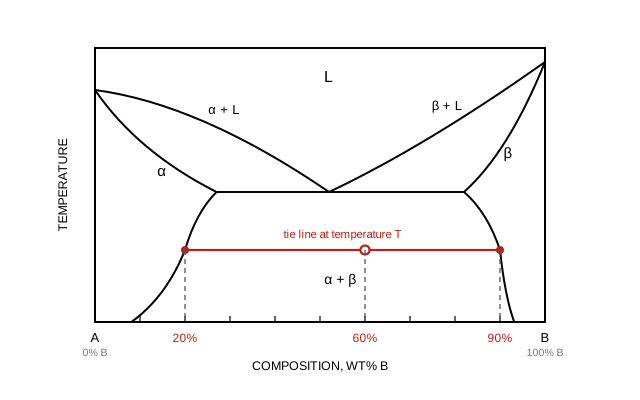
An alloy at \( 60\,\mathrm{wt\%\ B} \) lies in a two-phase field in which the \( \alpha \) phase contains \( 20\,\mathrm{wt\%\ B} \) and the \( \beta \) phase contains \( 90\,\mathrm{wt\%\ B} \). The weight percent of \( \alpha \) is most nearly:
Answer: A) 43%
Step 1 – Identify given information: \( x = 60 \), \( x_{\alpha} = 20 \), \( x_{\beta} = 90 \).
Step 2 – Lever rule (Handbook p. 128):
$$\mathrm{wt\%}\ \alpha = \dfrac{x_{\beta} - x}{x_{\beta} - x_{\alpha}} \times 100$$
Step 3 – Substitute and solve:
$$\mathrm{wt\%}\ \alpha = \dfrac{90 - 60}{90 - 20} \times 100 = \dfrac{30}{70} \times 100 = 42.9\%$$
Step 4 – Answer: About \( 43\% \) \( \alpha \), and therefore \( 57\% \) \( \beta \). The overall composition sits closer to the \( \beta \) boundary than to the \( \alpha \) one, so \( \beta \) has to be the more abundant phase, which is a useful check before the arithmetic is even finished.
Option (B) is the weight percent of \( \beta \), obtained by using the near arm rather than the far one. Option (C) divides the overall composition by the \( \beta \) boundary. Option (D) reports the width of the tie line, \( 90 - 20 = 70 \), as though it were a percentage of a phase.
Correct answer: (A)
Problem 3 — C. Physical and mechanical properties of metals, concrete, aggregates, asphalt, and wood
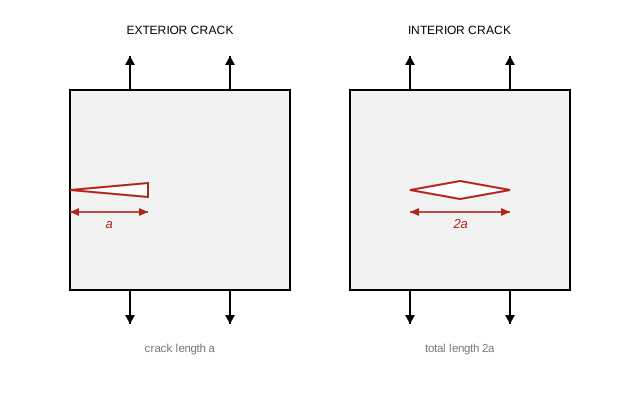
A wide steel plate contains an interior crack of total length \( 2a = 8.0\,\mathrm{mm} \) and carries a tensile stress of \( 400\,\mathrm{MPa} \). Taking the geometrical factor as \( Y = 1 \), the stress intensity is most nearly:
Answer: B) \( 44.8\,\mathrm{MPa}\sqrt{\mathrm{m}} \)
Step 1 – Identify given information: the crack is interior and its total length is \( 2a = 8.0 \) mm, so the value that goes into the formula is the half-length \( a = 4.0 \) mm \( = 0.0040 \) m. Handbook p. 123 defines it this way in its figure: an interior crack is drawn with \( 2a \) across it and takes \( Y = 1 \), while an exterior crack is drawn with \( a \) and takes \( Y = 1.1 \).
Step 2 – Fracture toughness relation (Handbook p. 123):
$$K_{IC} = Y \sigma \sqrt{\pi a}$$
Step 3 – Substitute and solve:
$$K_{IC} = (1)(400)\sqrt{\pi (0.0040)} = 400\sqrt{0.01257} = 400 (0.1121) = 44.8\ \mathrm{MPa}\sqrt{\mathrm{m}}$$
Step 4 – Answer: About \( 44.8\ \mathrm{MPa}\sqrt{\mathrm{m}} \). Compare that with the representative values on the same page: 4340 steel is listed at \( 46 \), so a plate of that grade with this crack is right at the edge of catastrophic propagation, while 52100 steel at \( 14.3 \) would have failed long before.
Option (D) uses the full \( 8.0 \) mm as \( a \) instead of the half-length, which is the error the figure on p. 123 exists to prevent. Option (A) halves the crack twice. Option (C) applies \( Y = 1.1 \), which belongs to an exterior surface crack rather than an interior one.
Correct answer: (B)
Problem 4 — A. Mix design of concrete and asphalt
A batch contains cement = \( 300\,\mathrm{kg} \) (SG = 3.15), water = \( 180\,\mathrm{kg} \), coarse aggregate = \( 1050\,\mathrm{kg} \) (SG = 2.65), fine aggregate = \( 700\,\mathrm{kg} \) (SG = 2.60), and air = \( 2\% \). What is the approximate yield of this batch (m\(^{3}\))?
Answer: D) 0.96
Step 1 – Identify given information:
| Cement | \( 300 \;\text{kg},\; SG = 3.15 \) |
| Water | \( 180 \;\text{kg} \) |
| Coarse aggregate | \( 1050 \;\text{kg},\; SG = 2.65 \) |
| Fine aggregate | \( 700 \;\text{kg},\; SG = 2.60 \) |
| Air | \( 2\% \) |
Step 2 – Yield by absolute volume method:
Yield is the total volume of all components. Each solid component volume is \( V_i = m_i / (SG_i \times 1000) \).
Step 3 – Compute each volume and sum:
\( V_c = \dfrac{300}{3150} = 0.095 \;\text{m}^3 \)
\( V_w = \dfrac{180}{1000} = 0.180 \;\text{m}^3 \)
\( V_{ca} = \dfrac{1050}{2650} = 0.396 \;\text{m}^3 \)
\( V_{fa} = \dfrac{700}{2600} = 0.269 \;\text{m}^3 \)
\( V_{air} = 0.020 \;\text{m}^3 \)
\( Y = 0.095 + 0.180 + 0.396 + 0.269 + 0.020 = 0.960 \;\text{m}^3 \)
Step 4 – Answer: The batch yield is approximately \( 0.96 \;\text{m}^3 \), meaning this batch produces slightly less than 1.00 m\(^{3}\). If the design target is 1.00 m\(^{3}\), all ingredient masses would need to be scaled up by \( 1/0.96 \approx 1.04 \).
Option (A) is the yield you get when the water volume is left out of the absolute-volume sum, which is easy to do because water is the one ingredient given without a specific gravity. Water still occupies volume: \(180\,\mathrm{kg}\) of it is \(0.180\,\mathrm{m}^{3}\).
Correct answer: (D)
Problem 5 — C. Physical and mechanical properties of metals, concrete, aggregates, asphalt, and wood
Diffusion follows \( D = D_0 \exp(-Q/RT) \). For \( Q = 80\,\mathrm{kJ/mol} \), what is approximately the ratio \( D(700\,\mathrm{K})/D(600\,\mathrm{K}) \)?
Answer: D) 9.9
Step 1 – Identify given information:
| Activation energy | \( Q = 80 \;\text{kJ/mol} = 80{,}000 \;\text{J/mol} \) |
| Temperature 1 | \( T_1 = 600 \;\text{K} \) |
| Temperature 2 | \( T_2 = 700 \;\text{K} \) |
| Gas constant | \( R = 8.314 \;\text{J/(mol·K)} \) |
Step 2 – Arrhenius equation for diffusion ratio:
Since \( D = D_0 \exp(-Q/RT) \), the ratio at two temperatures is:
\( \dfrac{D(T_2)}{D(T_1)} = \exp\left[-\dfrac{Q}{R}\left(\dfrac{1}{T_2} - \dfrac{1}{T_1}\right)\right] \)
Step 3 – Substitute and solve:
\( \dfrac{1}{T_2} - \dfrac{1}{T_1} = \dfrac{1}{700} - \dfrac{1}{600} = 0.001429 - 0.001667 = -2.381 \times 10^{-4} \)
\( -\dfrac{Q}{R} \times \left(-2.381 \times 10^{-4}\right) = \dfrac{80{,}000}{8.314} \times 2.381 \times 10^{-4} = 9{,}622 \times 2.381 \times 10^{-4} = 2.291 \)
\( \dfrac{D(700)}{D(600)} = e^{2.291} \approx 9.9 \)
Step 4 – Answer: The diffusion coefficient at 700 K is approximately 9.9 times that at 600 K. This demonstrates the strong exponential dependence of diffusion on temperature. A 100 K increase nearly increases D by a factor of 10.
Correct answer: (D)
Using the FE Reference Handbook for Materials
Materials answers live in two places. Search absolute volume for concrete batching and the specific gravity relationships, and go to the Civil Engineering Materials pages for asphalt mix properties, aggregate gradation, and steel designations. The stress-strain definitions sit in Mechanics of Materials, not Materials. Learn both locations by name before exam day so you are not searching a generic word like strength under time pressure.
Four Mistakes That Cost Points
- Ignoring the aggregate moisture correction Mix design proportions assume saturated surface-dry aggregate. When the problem gives a moisture content above or below absorption, you must adjust both the aggregate batch weight and the mixing water. Candidates compute the design batch correctly and then report it without the correction.
- Reading ultimate strength instead of yield On a stress-strain curve the peak is ultimate strength, but design questions usually want yield, found at the proportional limit or by the 0.2 percent offset line. If the curve has no sharp knee, the offset construction is required, not the highest point on the plot.
- Confusing the specific gravity terms in asphalt volumetrics Asphalt problems throw Gmb, Gmm, Gsb, and Gse at you in one sentence. Air voids use bulk and maximum theoretical specific gravity; VMA uses bulk aggregate specific gravity. Picking the wrong G gives a clean-looking number that often matches a distractor.
- Treating hardness, strength, and stiffness as one property Modulus of elasticity is stiffness, yield is strength, Brinell or Rockwell numbers are hardness, and area under the curve is toughness. Questions often describe a material qualitatively and ask which property changed; heat treating steel can raise hardness while cutting ductility with no change in modulus.
Frequently Asked Questions
How many Materials questions are on the FE Civil exam?
NCEES allocates 5 to 8 questions to Materials out of 110 on the FE Civil exam. That is a small block, but the questions are among the fastest on the test because most reduce to one handbook equation or a single table lookup. Getting all of them is realistic and buys time for longer structural or water resources problems.
Do I need to memorize concrete mix design procedures?
No. The absolute volume method, specific gravity relationships, and water-cement ratio are all in the FE Reference Handbook. What you need is the sequence: convert each ingredient weight to volume using its specific gravity and the unit weight of water, sum them, and let the aggregate fill the remainder of the cubic yard or cubic meter.
Is asphalt mix design tested as heavily as concrete?
Concrete appears more often, but asphalt shows up regularly through volumetrics: air voids, voids in mineral aggregate, voids filled with asphalt, and effective binder content. The arithmetic is short once you have the right specific gravities identified. Practice a few volumetric problems so the symbols stop looking interchangeable under exam pressure.
What is the fastest way to study Materials for the FE Civil exam?
Work problems rather than reading. Spend one session on concrete batching and moisture corrections, one on asphalt volumetrics and gradation, and one on stress-strain interpretation and material property comparisons. Three focused sessions cover the entire NCEES outline for this area, which is why Materials is usually the best return per hour on the whole exam.
Keep Going
Done with materials? Work through the other FE Civil knowledge areas with more free practice problems, review the full FE Civil exam topic breakdown, or plan your preparation with our FE exam study guide and study timeline. Or test yourself against the clock with the free FE Civil practice exam: 20 timed questions in the CBT format.